
Why So Many People Feel Uncertain About AI
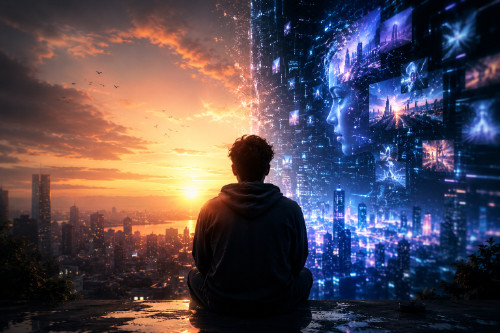
Artificial Intelligence is probably one of the biggest technological shifts many of us will experience in our lifetime. And like every major disruption in history, it brings both excitement and fear.
A lot of people are understandably anxious right now. Young people entering the workforce worry about jobs and stability. Artists worry about creativity becoming automated. Workers across many industries — from engineers to musicians to designers — are wondering where they fit into this new world.
Those concerns are real and shouldn’t be dismissed.
At the same time, AI is not likely to disappear from our lives. The technology is already deeply integrated into business, medicine, education, entertainment, research, communication, and creativity. The conversation now is less about stopping it and more about learning how humanity adapts to it responsibly.
Why AI Also Creates New Opportunities
Personally, I see more positive possibilities than negative ones.
AI allows individuals to do things that previously required large companies, large budgets, or gatekeepers. Independent creators can now make music, videos, art, websites, stories, and ideas with tools that simply didn’t exist before. It lowers barriers and gives opportunities to people who may never have had access to traditional industries.
In music specifically, AI can help creators experiment faster, visualize ideas, overcome technical limitations, and bring emotions and stories to life in new ways. But at the end of the day, tools still need human direction, human feeling, and human meaning behind them.
Why Human Connection Still Matters
No matter how advanced AI becomes, humans will still seek out human connection. We are emotional beings. We connect through imperfections, shared experiences, flaws, vulnerability, humor, struggle, and empathy. Technology may become incredibly powerful, but people will still look for something real in one another.
That human need for emotional authenticity is something machines alone cannot replace.
How Humans and AI Both Learn Through Observation
There’s also an uncomfortable but important conversation around imitation, learning, and originality.
Human beings themselves learn by observing, adapting, remixing, studying, and evolving from what came before them. Art, music, language, science, and culture have always evolved this way. In many ways, AI systems are doing something similar — just at a scale and speed far beyond human capability. We designed machines to learn patterns, mimic understanding, and improve from information, essentially creating accelerated reflections of some aspects of ourselves.
Even invention itself is often more complicated than people admit. Take something as simple as a chair or a table. Human beings across different parts of the world would likely arrive at similar ideas independently because the function naturally leads to similar solutions. Innovation has always involved observing, adapting, improving, and building upon what came before us. Much of human progress evolves collectively over time rather than appearing from a single isolated moment of originality.
That doesn’t mean every concern disappears. Questions around consent, originality, ethics, and compensation still matter greatly, especially in creative industries.
AI Didn’t Create the Music Industry’s Problems
At the same time, the existence of AI does not automatically mean someone else would have succeeded without it. In music especially, many artists struggled long before AI existed. The industry has historically been controlled by gatekeepers, corporations, marketing budgets, algorithms, trends, and timing. For decades, countless talented musicians never received major opportunities despite the absence of AI.
AI replacing one barrier does not automatically mean another person would have received that exact opportunity instead.
Ultimately, audiences still decide what resonates emotionally. Sometimes technically perfect work fails while something raw, strange, imperfect, or unexpected connects deeply with people. History is full of one-hit wonders, unconventional artists, and songs that broke every supposed industry rule yet still succeeded because people felt something real in them.
Technology may change the tools, but human emotional connection still determines lasting value.
The Real Concerns Around AI
Of course, there are real concerns too.
The companies building powerful AI systems may end up having enormous influence over society. Competition between companies like OpenAI, DeepSeek, Anthropic, Google, and others may help prevent too much centralized control, but it’s still something society should pay attention to carefully.
There are also hidden costs:
massive power usage, resource demands, environmental impact, and the pressure AI may place on workers and industries trying to adapt quickly.
Technology has never arrived without trade-offs.
Technology Has Always Changed Human Society
History also shows us something important:
major technological shifts often create fear at first, yet over time they also create new opportunities, industries, careers, and ways for people to express themselves.
The internet changed the world.
Smartphones changed the world.
Social media changed the world.
AI will too.
The challenge is not simply whether AI exists. The challenge is whether we can use it with balance, self-control, ethics, creativity, and humanity still at the center.
Staying Human in an Increasingly Synthetic World
That’s part of the emotional idea behind my song “Synthetic Dreams.”
Not fear of technology itself — but the feeling many people experience today of trying to stay human, connected, and emotionally real in a world becoming increasingly synthetic.